Auth0 vs Okta: Same Company, Different Products
Okta owns Auth0, but they solve different problems. Which one fits your users, what each costs in 2026, and what to pick if neither does.
 Leonard Hußke••8 min read
On this page
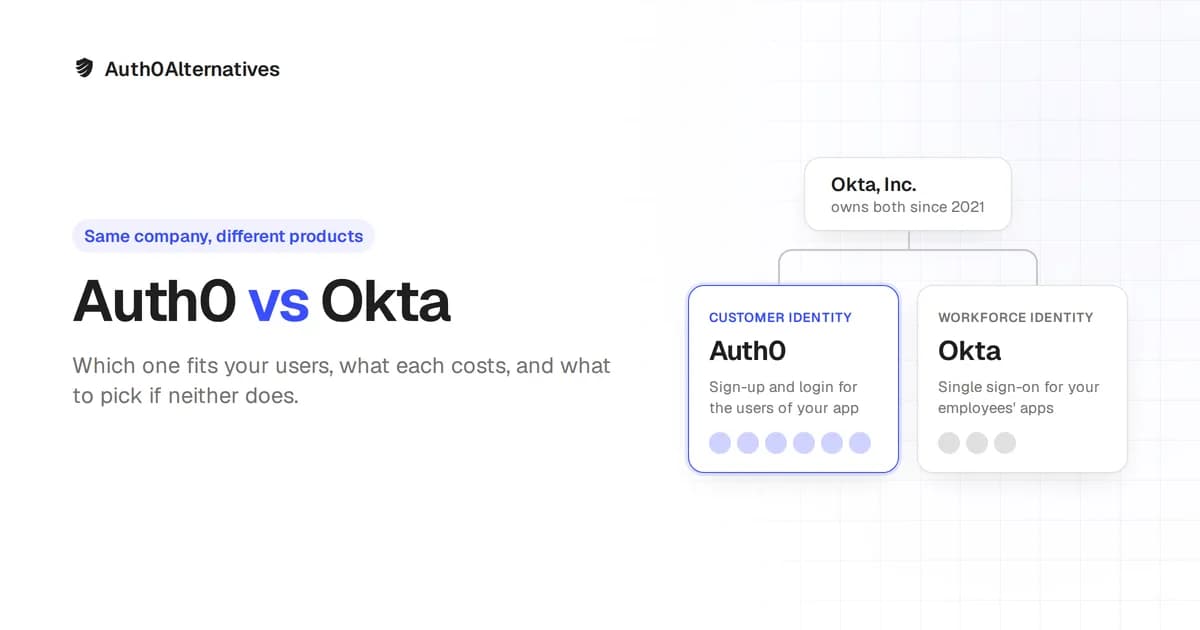
Okta owns Auth0, but the two are different products. Okta Workforce Identity signs your employees in to the apps your company uses. Auth0 handles sign-up and login for the users of the app you build. If you are adding login to a product, you want Auth0 or one of its alternatives. If your IT team needs single sign-on for Slack and Salesforce, you want Okta Workforce Identity.
A third product makes the comparison harder. Okta Customer Identity is a customer-identity platform built on Okta's own stack, sold on annual contracts from $3,000 a month. This post compares the three products on who they are for, what they cost, and what they do, and names alternatives for when none of them fits.
- Auth0 is customer identity (CIAM) for developers. It is free up to 25,000 monthly active users, and paid plans start at $35 a month.
- Okta Workforce Identity is single sign-on for employees. It costs from $6 per user a month, with a $1,500 annual minimum.
- Okta Customer Identity is customer identity for large companies that already use Okta. It starts at $3,000 a month on an annual contract.
- Okta bought Auth0 in 2021 for about $6.5 billion. Customer identity, including Auth0, is now 41% of Okta's annual contract value.
Is Auth0 owned by Okta?
Yes. Okta announced it would buy Auth0 on 3 March 2021, "in a stock transaction valued at approximately $6.5 billion". The deal closed on 3 May 2021. Okta said then that "Auth0 will operate as an independent business unit within Okta".
For a while, Okta marketed Auth0 as "Okta Customer Identity Cloud, powered by Auth0". In 2023, Auth0 told its users that the "Auth0 name remains". Today, Okta's customer-identity product page redirects to auth0.com, and Okta's pricing page sends you to Auth0 for Auth0's prices.
Okta's business splits about 60 to 40 between employee and customer identity. In its latest quarter, Okta reported revenue of $805 million and split its annual contract value (ACV) between the two product lines as follows:
Okta's annual contract value by product line
Share of total ACV, quarter ended 31 July 2026
- Workforce Identity59%
- Customer Identity41%
Source: Okta Q2 FY2027 shareholder commentary
Show data
| Share of ACV | |
|---|---|
| Workforce Identity | 59% |
| Customer Identity | 41% |
Customer identity ACV grew 13% year over year, a little faster than workforce identity at 11%. The numbers give no sign that Okta is winding Auth0 down.
Auth0 vs Okta: who signs in decides
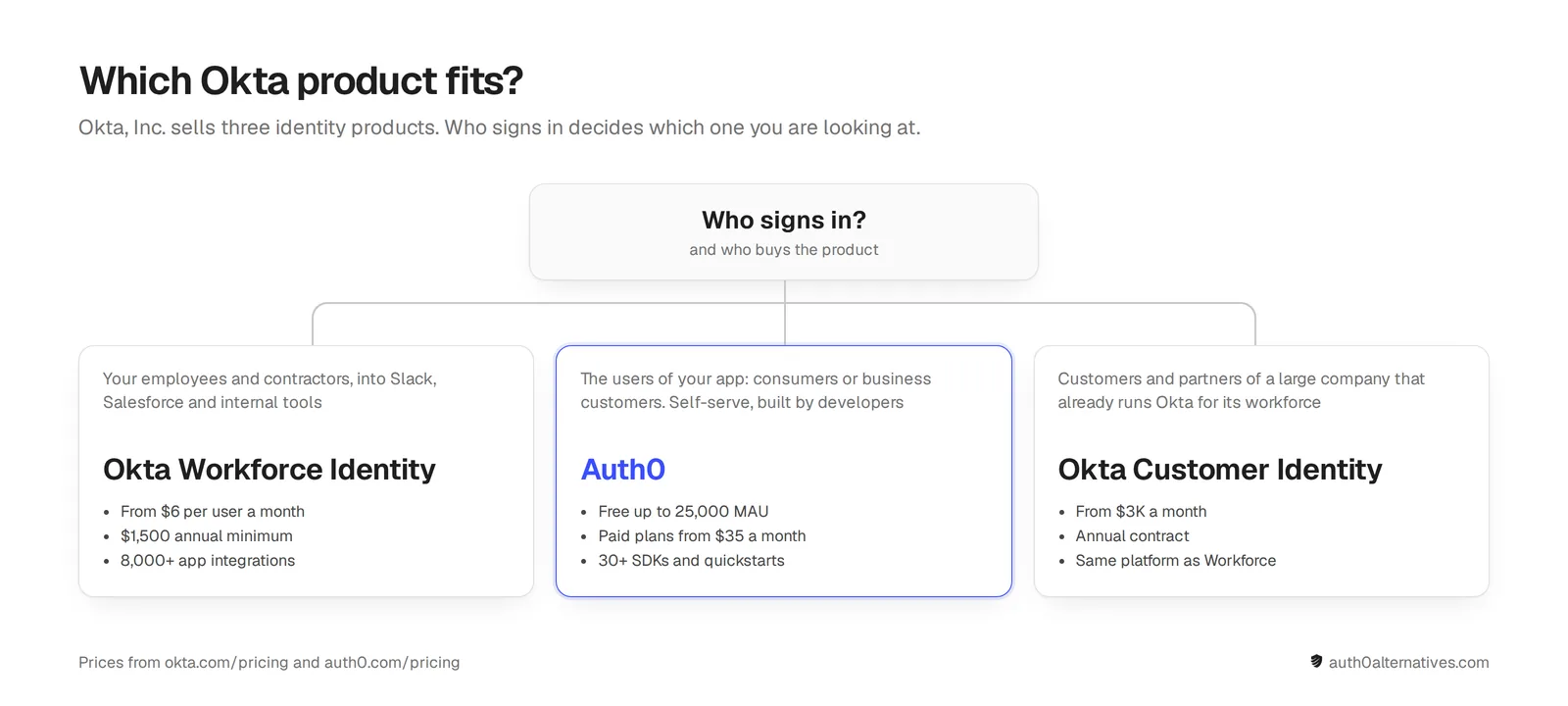
The product you need depends on who signs in and who buys it.
- Okta Workforce Identity is for "employees, contractors, and partners". Your IT team buys it, connects it to the company's apps, and controls who gets access. Its main advantage is the Okta Integration Network, which has more than 8,000 pre-built app integrations.
- Auth0 is for the people who use your product. Your developers add it with one of its "30+ SDKs and Quickstarts", style the login page, and pay per monthly active user.
- Okta Customer Identity is also for customers and partners. It runs on the "same secure, configurable, and easy-to-manage platform you already trust for your workforce". It suits large companies that already run Okta for employees and want one vendor and one admin console. Okta sells it only through its sales team.
Auth0 vs Okta compared
| Auth0 | Okta Workforce Identity | Okta Customer Identity | |
|---|---|---|---|
| Who signs in | The users of your app | Your employees and contractors | Customers and partners |
| Who buys | Developers and product teams | IT and security teams | Enterprise IT and digital teams |
| Pricing model | Per monthly active user | Per user per month, billed annually | Platform fee plus usage add-ons |
| Entry price | Free up to 25,000 MAU, paid plans from $35 a month | $6 per user a month, $1,500 annual minimum | $3,000 a month, annual contract |
| Self-serve sign-up | Yes, no credit card | 30-day free trial | No, sales only |
| Free plan for developers | The Free plan | Integrator Free Plan, 10 active users, not for production | No |
| Protocols | OAuth 2.0, OIDC, SAML, WS-Federation, LDAP, and SCIM | OAuth 2.0, OIDC, SAML, and SCIM | The same platform as Workforce Identity |
| B2B features | Organizations, enterprise connections, and self-service SSO | Not its focus | B2B Suite, priced on request |
| AI agents | Auth0 for AI Agents, generally available since November 2025 | Cross App Access | Not listed separately |
Auth0 pricing vs Okta pricing
Okta Workforce Identity charges per employee and Auth0 charges per monthly active user, so compare them by what you count.
Okta Workforce Identity charges per employee. The Starter suite costs $6 per user a month, Core Essentials costs $14, and Essentials costs $17. Okta prices Professional and Enterprise on request. Okta bills all suites annually, with a "$1,500 annual contract minimum" (Okta pricing). At list price, a 20-person company on Starter would pay $1,440 a year, so it pays the $1,500 minimum instead. From 21 users, the per-user price is higher than the minimum.
Auth0 charges per monthly active user (MAU) of your app. It has separate B2C and B2B plans. The Free plan covers up to 25,000 MAU with one custom domain, five organizations, and one enterprise connection. The paid plans add what Free leaves out, and their prices start at 500 MAU. Prices climb steeply with MAU, and at the same size the B2B plans cost several times as much as the B2C plans:
Auth0 monthly price by MAU
List price per month, billed monthly. Essentials and Professional plans, B2C and B2B
- B2C Essentials
- B2B Essentials
- B2B Professional
Source: auth0.com/pricing
Show data
| B2C Essentials | B2B Essentials | B2B Professional | |
|---|---|---|---|
| 500 | $35 | $150 | $800 |
| 1,000 | $70 | $300 | $800 |
| 2,500 | $175 | $700 | $1,200 |
| 5,000 | $350 | $1,300 | $1,500 |
| 7,500 | $525 | $1,725 | $1,800 |
| 10,000 | $700 | $2,100 | $2,400 |
| MAU | B2C Essentials | B2C Professional | B2B Essentials | B2B Professional |
|---|---|---|---|---|
| 500 | $35 | $240 | $150 | $800 |
| 1,000 | $70 | $240 | $300 | $800 |
| 2,500 | $175 | $545 | $700 | $1,200 |
| 5,000 | $350 | $1,000 | $1,300 | $1,500 |
| 10,000 | $700 | $1,600 | $2,100 | $2,400 |
| 20,000 | $1,400 | $3,200 | $3,800 | Contact sales |
The table shows monthly list prices from Auth0's pricing page. Annual billing costs 11 times the monthly price. Auth0's price slider stops at 30,000 MAU, and the Enterprise plan has no public price.
These prices explain why "Why is Auth0 so expensive?" is a common question. A few limits push teams onto higher plans sooner than their MAU count suggests:
- Enterprise connections run out. B2B Essentials includes 3, and B2B Professional includes 5. Each extra connection is an add-on, and every business customer that wants SSO through its own identity provider needs one.
- B2C plans drop enterprise SSO and SCIM. The Free plan includes them, but the B2C Essentials and Professional plans tell you to "Upgrade to B2B to continue using EC, Self-Service SSO, and SCIM."
- Log retention is short on the lower plans. Auth0 keeps logs for 1 day on Free, 5 days on Essentials, 10 days on Professional, and 30 days on Enterprise.
- Adaptive MFA and a HIPAA BAA need Enterprise. Both are add-ons to the Enterprise plan.
Okta Customer Identity starts at $3,000 a month. That price buys the Enterprise base platform. Okta prices the B2C and B2B suites on request, and the platform and all add-ons "require an annual contract".
Auth0 and Okta features follow the audience
Both products support the standard protocols: OAuth 2.0, OpenID Connect, and SAML, plus SCIM for provisioning. To choose between those protocols, read SAML vs OIDC vs OAuth.
Where the products differ, each one follows its audience.
- Extensibility. Auth0 Actions are "tenant-specific Node.js functions" that run at set points in the login flow. Developers use them to add custom claims, block sign-ups, or call their own APIs.
- B2B SaaS. Auth0 Organizations help "business-to-business (B2B) customers better manage their partners and customers", with a login page and enterprise connections for each organization. Okta Workforce Identity manages your own employees, not your customers' organizations.
- Authenticators. Okta's authenticators are built for employees and include Okta Verify, Okta FastPass, passkeys, smart cards, and YubiKey OTP. Auth0's factors cover what app users have: push notifications, SMS, voice calls, one-time passwords, WebAuthn security keys and biometrics, email, and recovery codes.
- Fine-grained authorization. Auth0 sells it as Auth0 FGA, "Built on OpenFGA". Okta's FGA page now redirects to Auth0 FGA.
- AI agents. Auth0 for AI Agents became generally available in November 2025. It covers user authentication, a Token Vault for third-party API tokens, and asynchronous authorization. For employees, Okta's Cross App Access lets one app connect to another.
Auth0 supports 52 of the 55 features that our directory tracks. Only Descope supports more, with 54. The Auth0 listing shows the full list.
Data residency and compliance
Auth0 lets you create tenants in the United States, Europe, the United Kingdom, Canada, Australia, and Japan. Okta runs "cells" in the US, EMEA, Japan, Australia, Canada, and India. For every provider that keeps data in the EU, see EU data residency.
Okta's trust center covers both products. Auth0 documents annual SOC 2 Type 2 audits and ISO 27001, 27017, and 27018 audits. It also has CSA STAR certification and signs a HIPAA BAA on request. The FedRAMP authorization on the trust center covers "Okta for Government", not Auth0. If you need FedRAMP for customer identity, ask Okta which product the authorization covers.
The 2023 Okta support breach
The incident buyers ask about most is Okta's October 2023 support-system breach. An attacker used a service account whose credentials "had been saved into the employee's personal Google account". With that account, the attacker accessed files of 134 Okta customers. Okta later found that the attacker had also downloaded the names and email addresses of all users of its customer support system. Okta said that "the Auth0/CIC support case management system was also not impacted by this incident".
Pick Auth0, Okta, or neither
If you need SSO and MFA for your own employees across SaaS apps, pick Okta Workforce Identity. It does not add login to a product you build.
If you build an app and want a mature, managed login, pick Auth0. Check its price at your MAU and plan first. Auth0 suits teams that use Actions, Organizations, and enterprise connections.
If your company already runs Okta for employees, pick Okta Customer Identity to get customer identity on the same platform and contract.
Pick neither in three cases. Auth0's price is the problem, you want to host your own auth, or you need SSO and SCIM for many B2B customers without paying per connection. These alternatives cover those cases:
| Alternative | Best for | Open source | Self-hosted | Compare |
|---|---|---|---|---|
| WorkOS | B2B SaaS that sells SSO and SCIM to enterprises | No | No | WorkOS vs Auth0 |
| Descope | The widest feature set in our directory, with visual flows | No | No | Descope vs Auth0 |
| Clerk | React and Next.js apps that want prebuilt UI | No | No | Clerk vs Auth0 |
| Amazon Cognito | Teams already on AWS | No | No | Cognito vs Auth0 |
| FusionAuth | Features like Auth0's that you run yourself | No | Yes | FusionAuth vs Auth0 |
| Keycloak | A free, mature open-source identity server | Yes | Yes | Keycloak vs Auth0 |
| Zitadel | Open-source, multi-tenant B2B identity | Yes | Yes | Zitadel vs Auth0 |
| Better Auth | A TypeScript library inside your own app | Yes | Yes | Better Auth vs Auth0 |
The directory lists all 37 providers.
FAQ
Yes. Okta completed its acquisition of Auth0 on 3 May 2021, in a deal valued at about $6.5 billion. Auth0 runs as a business unit within Okta and keeps its own brand.
Yes. "Okta Customer Identity Cloud, powered by Auth0" was a name that Okta used for Auth0 from 2023. Okta's product page for it now redirects to auth0.com. The separate product "Okta Customer Identity", without "Cloud", runs on Okta's workforce platform and is sold on annual contracts.
Yes. A common setup uses Okta Workforce Identity for employees and Auth0 for customers. They are separate products with separate contracts. If a business customer uses Okta for its employees, your Auth0 app can accept their logins through a SAML or OIDC enterprise connection.
Auth0 charges per monthly active user, and the B2B plans cost several times as much as the B2C plans at the same MAU. At 10,000 MAU, B2C Essentials is $700 a month and B2B Professional is $2,400. Extra enterprise connections, longer log retention, and adaptive MFA need higher plans or add-ons.
Not for production. The Okta Integrator Free Plan is for building and testing integrations, and it allows 10 active users. Workforce Identity has a 30-day free trial. Auth0's Free plan covers production apps up to 25,000 MAU.
The main managed alternatives for customer identity are WorkOS, Clerk, Descope, Stytch, Amazon Cognito, and FusionAuth. The main open-source options are Keycloak, Zitadel, Ory, and Better Auth. Our directory lists 37 auth providers, each with a comparison to Auth0.