Keycloak Alternatives: 14 Self-Hosted and Managed Options
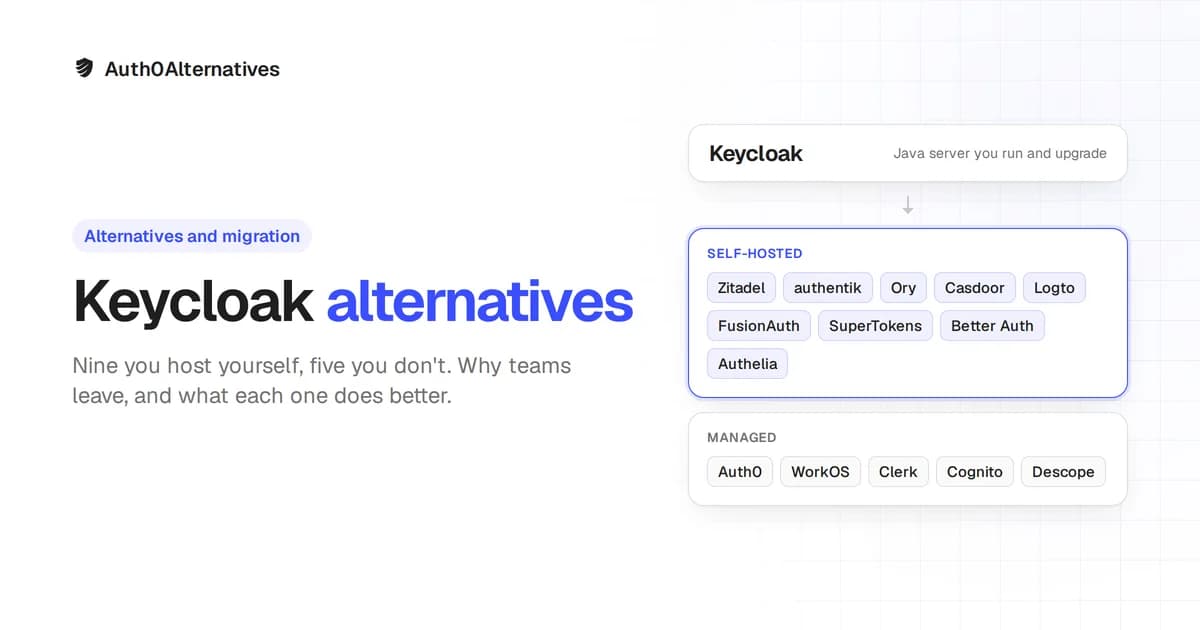
Why teams leave Keycloak and what to use instead: 9 self-hosted options like Zitadel and authentik, and 5 managed ones, compared on our data.
 Leonard Hußke••11 min read
On this page
Most teams look for Keycloak alternatives because of the work of running it, not because of missing features. If you want to stop operating an identity server, move to a managed provider such as Auth0, WorkOS, or Clerk. If you want to keep self-hosting, pick by the problem you have. Zitadel and Logto are built for multi-tenant B2B apps. authentik and Casdoor are full identity providers like Keycloak, without the Java runtime. Better Auth and SuperTokens put login inside your own app.
- Keycloak is free, Apache 2.0 licensed, and still gaining features. Version 26.4 added passkeys, and 26.8 made the SCIM API a supported feature.
- Upgrades are the main cost. Keycloak supports rolling updates only for patch releases. Every minor upgrade means shutting down the cluster, and it ships a new minor version every quarter.
- 15 of the 37 providers in our directory are open source, and 17 can be self-hosted. FusionAuth is one of the two that are self-hosted but not open source.
- The closest self-hosted replacements are Zitadel, authentik, and FusionAuth. Zitadel and FusionAuth document how to import Keycloak users with their password hashes.
Why teams look for a Keycloak alternative
Keycloak is a mature project. It is a CNCF incubating project with 38,005 stars on GitHub. It supports OpenID Connect, OAuth 2.0, and SAML, and it federates users from LDAP and Active Directory. Red Hat sells a supported build. The reasons to leave are about what it takes to run Keycloak.
Upgrades need downtime and a database backup. The Keycloak upgrading guide says to "Shut down Keycloak if no rolling update is supported, for example if you perform a minor or major upgrade." Rolling updates work for patch releases since Keycloak 26.6.0. The server migrates the database schema when it starts, and "Keycloak does not support rolling back the database changes". To roll back, you restore the old installation and the database backup.
Releases come often. Keycloak published 22 releases on GitHub in 2026 up to November, and four of them were minor versions (26.5 to 26.8). Each minor version needs the shutdown above.
Keycloak releases per year
Major, minor, and patch releases published on GitHub. 2026 runs to November
Source: Keycloak releases on GitHub
Show data
| Releases | |
|---|---|
| 2021 | 13 |
| 2022 | 13 |
| 2023 | 18 |
| 2024 | 23 |
| 2025 | 26 |
| 2026 | 22 |
Custom themes need work on every upgrade. Keycloak's login pages are FreeMarker templates, and you restyle them with a custom theme. The upgrading guide says that custom themes "must be migrated to the new server". You compare every template you customized with its new version.
Multi-tenancy came late. Keycloak separates tenants with realms, and each realm has its own users, clients, and settings. The Organizations feature, which groups the users of one business customer inside a realm, has been fully supported only since Keycloak 26 in October 2024. Products that were built for B2B SaaS from the start, such as Zitadel and Logto, model customers as organizations by default.
You run a Java server. Keycloak runs on Quarkus and needs a relational database. For high availability you run a cluster and size its caches. If nobody on your team owns that cluster, look at the managed options below.
Keycloak keeps adding features. Keycloak 26.8 promoted the SCIM API "from preview to supported", and 26.4 added passkeys and MCP authorization server metadata. If a missing feature is your only reason to leave, check the latest release first.
Keycloak alternatives compared
The table compares the alternatives on the features that Keycloak users ask about most. "Yes" and "No" come from our listings, checked against each provider's docs. Text cells add a condition, such as a paid plan or a commercial license.
| Provider | Hosting | License | SAML | SCIM | LDAP | Organizations |
|---|---|---|---|---|---|---|
| Keycloak | Self-hosted | Apache 2.0 | Yes | Yes, since 26.8 | Yes | Yes |
| Zitadel | Self-hosted or cloud | AGPL 3.0 | Yes | Yes | Yes | Yes |
| authentik | Self-hosted | MIT, plus an enterprise license | Yes | Yes | Yes | Yes |
| Ory | Self-hosted or cloud | Apache 2.0, plus an enterprise license | Enterprise license | Enterprise license | Yes | Enterprise license |
| Casdoor | Self-hosted or cloud | Apache 2.0 | Yes | Yes | Yes | Yes |
| Logto | Self-hosted or cloud | MPL 2.0 | Yes | No | No | Yes |
| FusionAuth | Self-hosted or cloud | Proprietary, free Community plan | Yes | Enterprise plan | Paid plans | Yes |
| SuperTokens | Self-hosted or cloud | Apache 2.0, plus paid features | Paid feature | No | No | Paid feature |
| Better Auth | In your app | MIT | Yes | Yes | No | Yes |
| Authelia | Self-hosted | Apache 2.0 | No | No | Yes | No |
| Auth0 | Managed | Proprietary | Yes | Yes | Yes | Yes |
| WorkOS | Managed | Proprietary | Yes | Yes | No | Yes |
| Clerk | Managed | Proprietary | Yes | Pro plan | No | Yes |
| Amazon Cognito | Managed | Proprietary | Yes | No | No | No |
| Descope | Managed | Proprietary | Yes | Yes | Yes | Yes |
Our directory tracks 55 features per provider. The chart counts how many of them each option supports. Keycloak's count of 38 doesn't include the SCIM API from 26.8 yet.
Features supported, Keycloak and its alternatives
Number of the 55 features that the Auth0Alternatives directory tracks
- Descope54
- Auth052
- Ory48
- WorkOS48
- FusionAuth47
- Better Auth42
- Zitadel41
- authentik41
- SuperTokens39
- Keycloak38
- Clerk38
- Casdoor37
- Logto36
- Amazon Cognito32
- Authelia20
Source: Auth0Alternatives listings
Show data
| Features (of 55) | |
|---|---|
| Descope | 54 |
| Auth0 | 52 |
| Ory | 48 |
| WorkOS | 48 |
| FusionAuth | 47 |
| Better Auth | 42 |
| Zitadel | 41 |
| authentik | 41 |
| SuperTokens | 39 |
| Keycloak | 38 |
| Clerk | 38 |
| Casdoor | 37 |
| Logto | 36 |
| Amazon Cognito | 32 |
| Authelia | 20 |
A higher count doesn't mean a better fit. Authelia scores low because it does one job, SSO and two-factor login in front of a reverse proxy, and it doesn't try to do more.
Open-source Keycloak alternatives you can self-host
15 of the 37 providers in our directory are open source, and every one of them can be self-hosted. Among those 15, 13 support SAML, 10 support organizations, and 5 have SCIM in our listings, 6 with Keycloak 26.8. The open-source and self-hosted pages list them all.
| Project | GitHub stars | Written in |
|---|---|---|
| Keycloak | 38,005 | Java |
| Better Auth | 30,838 | TypeScript |
| Authelia | 29,710 | Go |
| authentik | 26,418 | Python |
| Ory Hydra | 17,675 | Go |
| Zitadel | 15,637 | Go |
| SuperTokens | 15,347 | Java |
| Logto | 14,973 | TypeScript |
| Casdoor | 14,929 | Go |
| Ory Kratos | 13,963 | Go |
The star counts come from each project's main repository on GitHub in November 2026.
Zitadel: multi-tenant B2B identity
Zitadel is the closest match if you use Keycloak realms to separate customers. Its data model has instances at the top, and "One instance can contain multiple organizations". It is a Go server that needs only PostgreSQL. It supports OpenID Connect, SAML 2.0, a SCIM 2.0 server, passkeys, and LDAP as a login source. It is OpenID Certified.
Zitadel moved its server from Apache 2.0 to AGPL 3.0 with version 3 in 2025. Its APIs and SDKs stay under Apache 2.0. Check the AGPL with your legal team if you modify the server. Zitadel Cloud is free for 100 daily active users, and the Pro plan costs $100 a month with 25,000 daily active users included.
Zitadel documents the most complete migration path off Keycloak. Its Keycloak migration guide converts a Keycloak realm export with the zitadel-tools CLI and imports users "including password hashes".
authentik: a full identity provider in Python
authentik covers the protocols most teams use Keycloak for: SAML, OAuth 2.0 and OIDC, LDAP, RADIUS, SCIM, and passkeys. It is written in Python and runs on PostgreSQL alone since version 2025.10, which removed the need for Redis. Docker Compose needs at least 2 CPU cores and 2 GB of RAM.
The core is MIT licensed. Enterprise features cost $5 per workforce user a month and $0.02 per customer user a month, billed annually. authentik has no hosted version. Its multi-tenancy feature is an Enterprise feature in alpha, so for B2B SaaS with many customers, Zitadel is the safer choice.
Ory: headless identity APIs
Ory splits identity into separate Go services. Kratos handles users and login, Hydra is an OpenID Certified OAuth 2.0 and OIDC provider, Keto handles permissions, and Oathkeeper is a proxy. Every core service is Apache 2.0. Kratos is headless, so you build the login UI yourself, optionally with the Ory Elements component library.
The trade-off is in the license. SAML, SCIM, and B2B organizations are part of the Ory Enterprise License, not the open-source build. Ory Network, the managed version, starts at $770 a year for one production environment. Pick Ory if you want full control of the UI and can staff the integration work.
Casdoor: one server with every protocol
Casdoor is a Go server with a React admin UI under Apache 2.0, like Keycloak. It acts as an OAuth 2.0 and OIDC provider, a SAML IdP, and a CAS server, and it also serves LDAP and RADIUS. Several organizations share one Casdoor, "each with its own users, groups, roles, applications, and branding". It runs on MySQL, PostgreSQL, SQL Server, SQLite, and other databases.
Casdoor has a Keycloak syncer that reads users from Keycloak's database schema. You can run both side by side and move apps one at a time. Its hosted plans start at $9 a month.
Logto: developer-first, with organizations
Logto is a TypeScript and Node.js server on PostgreSQL under MPL 2.0. It uses "organization" as its term for multi-tenancy, and it supports OIDC, OAuth 2.1, SAML apps, and passkeys. It has no SCIM and no built-in LDAP sync, so it fits SaaS products better than corporate directories.
Logto Cloud is free up to 50,000 MAU. The Pro plan starts at $24 a month, and organizations and enterprise SSO are $48 a month add-ons each.
FusionAuth: a single server, free but not open source
FusionAuth is the most direct swap for Keycloak's role: one Java application, PostgreSQL or MySQL, and optional Elasticsearch for search. It acts as a SAML identity provider, supports WebAuthn, and has tenants. The Community plan is free and self-hosted. FusionAuth is proprietary software, though, so you can't change or fork the code. LDAP connectors start on paid plans, and SCIM is on the Enterprise plan.
The FusionAuth Keycloak migration guide exports users with SQL from Keycloak's tables. FusionAuth ships a Keycloak-compatible PBKDF2 hashing plugin since version 1.34, so users keep their passwords.
SuperTokens: login inside your backend
SuperTokens has a core service plus backend SDKs for Node.js, Python, and Go and prebuilt or custom UI. Your app owns the login screens and sessions instead of redirecting to a separate server. The core is Apache 2.0, and "Self hosting the open source features is free without any limits". Some features, such as MFA, multi-tenancy, and SAML, are paid. The managed version is free under 5,000 MAU, then $0.02 per MAU.
Better Auth: a TypeScript library
Better Auth is not a server at all. It is an MIT-licensed TypeScript framework that runs inside your app and stores users in your database through Prisma, Drizzle, Kysely, or MongoDB adapters. Plugins add organizations, passkeys, SSO over OIDC or SAML 2.0, and an inbound SCIM 2.0 service. It acts as the service provider in SSO, not as an identity provider for your other apps.
Pick Better Auth if Keycloak protects one TypeScript product and nothing else. If Keycloak is the central login for many apps, it is the wrong replacement.
Authelia: SSO in front of a reverse proxy
Authelia is a companion for reverse proxies such as nginx, Traefik, Caddy, and HAProxy. It allows, denies, or redirects requests and adds two-factor login. It is also an OpenID Certified OpenID Connect provider. Users live in LDAP or a YAML file. Authelia doesn't support SAML yet, which is still in planning on its roadmap.
Authelia suits homelabs and internal tools behind a proxy. For SAML apps or customer sign-up, use authentik instead.
Managed Keycloak alternatives
A managed provider removes the work that drives most teams off Keycloak: no cluster, no upgrades, no database migrations. The cost moves to a monthly bill per user and per enterprise connection.
- Auth0 is free up to 25,000 MAU, and paid plans start at $35 a month. B2B plans include 3 to 5 enterprise connections, and each extra connection costs $100 a month. Its bulk import accepts custom password hashes, Argon2 and PBKDF2 among them. The Auth0 vs Okta post covers its plans in detail.
- WorkOS is free for the first million users of AuthKit. Enterprise SSO and Directory Sync cost $125 per connection a month for the first 15 connections, with lower prices at volume. It suits B2B SaaS that sells SSO to enterprises.
- Clerk is free up to 50,000 monthly retained users per app. Pro costs $25 a month, or $20 billed annually, with one SSO connection included and $75 a month for each extra connection. It suits React and Next.js apps that want prebuilt UI.
- Amazon Cognito gives 10,000 MAU free per AWS account on its Lite and Essentials tiers. SAML and OIDC federation is free for 50 MAU and then billed per user, with no fee per connection. It suits teams that already run on AWS.
- Descope is free up to 7,500 MAU with 3 SSO connections, and Pro starts at $249 a month. It has a Keycloak migration guide that imports password hashes or migrates users on their next login.
How to move off Keycloak
The hard part of a migration is the passwords. If the new provider can't read Keycloak's password hashes, every user has to reset their password.
- Export the realm and its users.
kc.sh exportwrites realms and users to JSON files. Keycloak's docs recommend stopping all nodes before you export, because a running cluster gives no consistency guarantee. - Check which hash algorithm your users have. Keycloak 24 changed the default from PBKDF2-SHA256 to PBKDF2-SHA512. Keycloak 25 switched the default to Argon2 outside FIPS mode. Keycloak rehashes a password on the user's next login, so an old realm often has a mix.
- Confirm that the target imports those hashes. Zitadel and Descope document Keycloak imports with hashes. FusionAuth's plugin covers Keycloak's PBKDF2 hashes. Auth0, Clerk, WorkOS, and Cognito accept Argon2 and some PBKDF2 variants. SuperTokens lists bcrypt, Argon2, and Firebase scrypt, so PBKDF2 users would need a reset.
- Move apps one at a time. Keep Keycloak running and connect it to the new provider as an external OIDC or SAML identity provider. Casdoor and authentik both describe this side-by-side approach. To choose the protocol for each app, read SAML vs OIDC vs OAuth.
The feature pages for user import and password export list which providers support each step.
Pick the Keycloak alternative by the problem you have
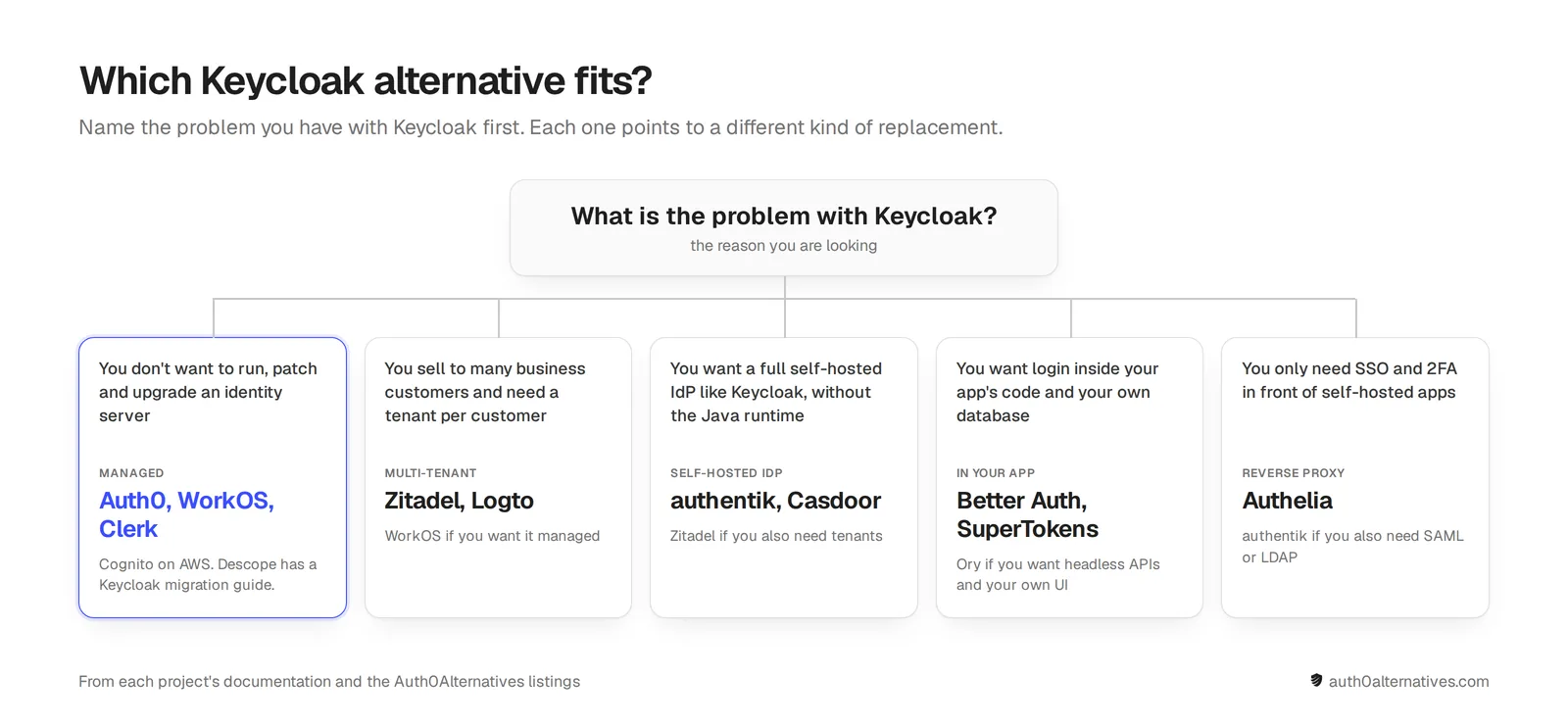
If running Keycloak is the problem, pick a managed provider. Choose WorkOS for B2B SaaS that sells enterprise SSO, Clerk for React apps, Cognito on AWS, and Auth0 for the broadest feature set.
If you sell to many business customers, pick Zitadel. It has organizations at its core, a SCIM server, and a documented Keycloak import with password hashes. The B2B providers page and the organizations feature page list more options.
If you want Keycloak's scope without the Java runtime, pick authentik or Casdoor. If you want one server in Keycloak's role and accept a free proprietary license, pick FusionAuth.
If Keycloak protects only your own app, pick Better Auth for TypeScript or SuperTokens for Node.js, Python, and Go backends.
If you only need SSO in front of internal tools, pick Authelia.
If none of these problems applies to you, stay on Keycloak and plan for its quarterly upgrades. It is free, it now has SCIM and passkeys, and its SAML and LDAP support is broader than most alternatives offer.
FAQ
For a full identity provider, Zitadel or authentik. Zitadel fits multi-tenant B2B apps and imports Keycloak users with their password hashes. authentik covers SAML, OIDC, LDAP, RADIUS, and SCIM in one Python server on PostgreSQL. Both are free to self-host.
Yes. Keycloak is licensed under Apache 2.0, and the project has no paid edition. You pay for the servers, the database, and the time to run and upgrade it. Red Hat sells a supported version, the Red Hat build of Keycloak.
For multi-tenant SaaS, often yes. Zitadel models customers as organizations inside an instance, and it runs as a Go server on PostgreSQL. Keycloak supports more protocols and has a larger community. Zitadel's server is AGPL 3.0, while Keycloak is Apache 2.0. See Zitadel vs Keycloak for the full comparison.
It needs less infrastructure. Since version 2025.10, authentik runs on PostgreSQL alone, and its Docker Compose setup needs 2 CPU cores and 2 GB of RAM. Keycloak runs on the JVM and needs cache tuning for a cluster. Both are full identity providers with SAML, OIDC, and LDAP.
Yes, if the target can read Keycloak's hashes. Zitadel, Descope, and FusionAuth document Keycloak imports with password hashes. Check whether your users have Argon2 or PBKDF2 hashes first, because Keycloak changed its default algorithm in versions 24 and 25.
Mostly because of the work of running it. Minor upgrades need a full cluster shutdown and a database backup, and a new minor version comes every quarter. Custom login themes need changes on upgrades. Organizations, Keycloak's model for B2B customers, has been fully supported only since version 26. Missing features are rarely the reason, because Keycloak now supports passkeys and SCIM.

 Descope
 Authsignal