What Is CIAM? Customer Identity vs IAM, and the Providers
CIAM is the sign-up, login and account layer for your app's users. How it differs from workforce IAM, what to look for, and which providers offer it.
 Leonard Hußke••12 min read
On this page
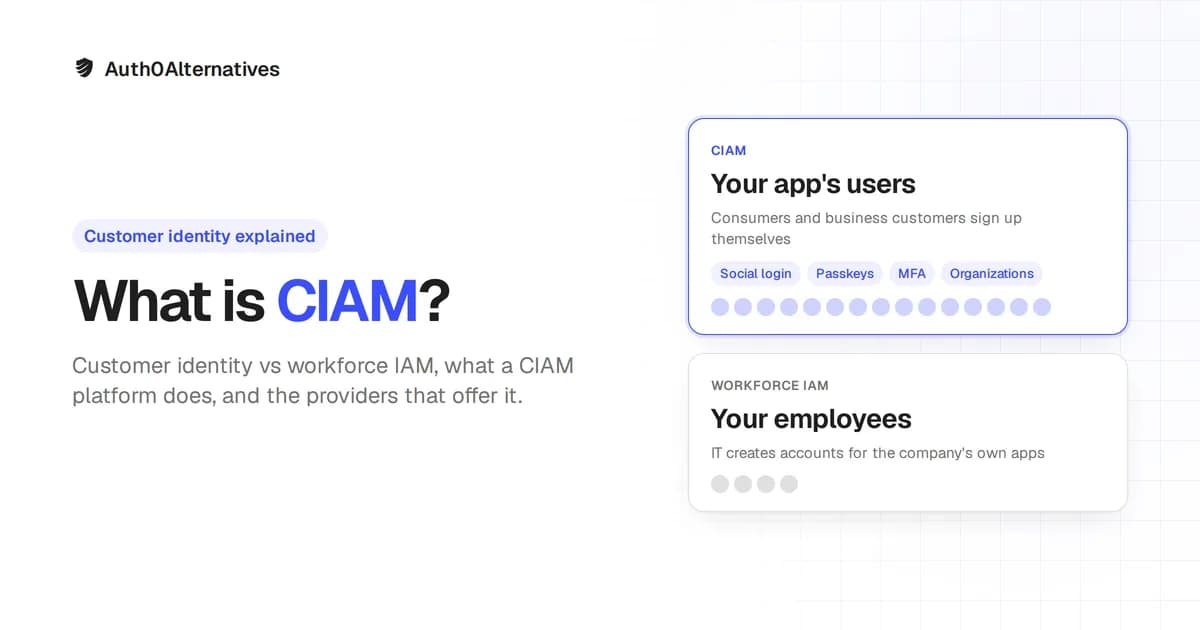
CIAM, or customer identity and access management, is the sign-up, login, and account layer for the people who use your product. Workforce IAM signs your employees in to the tools your company uses. CIAM signs in your customers: consumers in a B2C app, and the employees of your business customers in a B2B app. If you are adding login to a product, you need CIAM, and you will usually buy it as a managed platform or run an open-source one.
This post explains what CIAM is, how it differs from workforce IAM, what a CIAM platform does, and what to check before you pick one. It ends with the CIAM providers in our directory of 37 auth providers, grouped by B2C, B2B, and open source.
- CIAM manages the identities of people outside your organization. They sign up themselves, there can be millions of them, and they leave if login is slow.
- Workforce IAM manages employees and contractors. IT creates their accounts, and security and governance come before convenience.
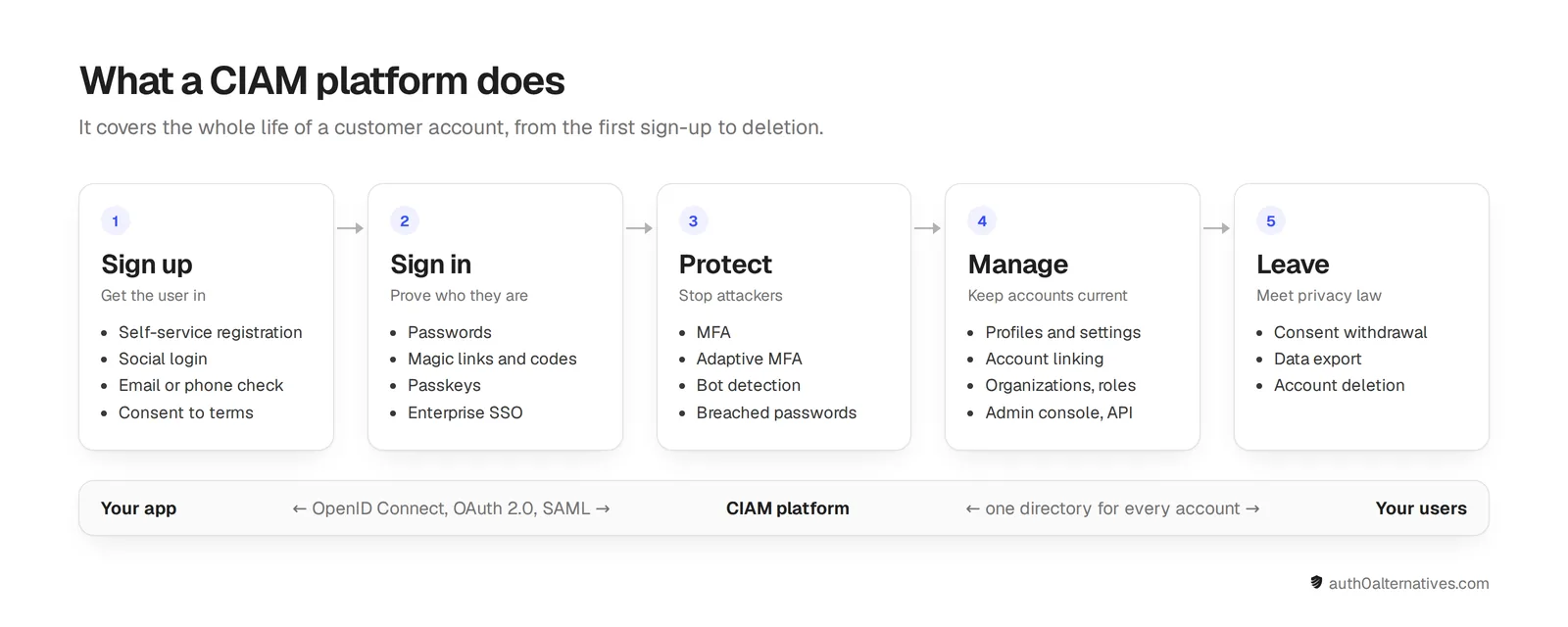
- A CIAM platform gives you hosted login, social login, passwordless and passkeys, MFA, B2B organizations, user management, and the tools to meet privacy law.
- All 37 providers in our directory offer passwordless login, 35 offer social login, and 30 support passkeys. Only 17 have organizations, enterprise SSO, and SCIM together.
What is CIAM?
Gartner defines customer identity and access management (CIAM) as "tools that provide features and functions to enable secure and frictionless access for key constituencies and use cases, including customers, partners and machine identities". Gartner published its first Magic Quadrant for CIAM on 28 October 2026, and Okta quotes that definition in its announcement of the report. Until 2025, Gartner covered these vendors in its broader Access Management Magic Quadrant.
The analyst firm KuppingerCole describes CIAM as "a specialized area within the broader Identity and Access Management (IAM) field, focusing on consumer-facing organizations". Its 2022 Leadership Compass for CIAM platforms adds that "SaaS delivery is the norm for CIAM services". The C sometimes stands for "consumer" instead of "customer". Both names mean the same thing.
For a developer, a CIAM platform is three things that work together:
- An identity provider. Your app redirects users to it, and it sends them back with tokens. Almost all CIAM platforms speak OpenID Connect and OAuth 2.0, and most also speak SAML. SAML vs OIDC vs OAuth explains the three protocols.
- A user directory. It stores profiles, credentials, sessions, roles, and consent records, and has an admin console and an API to manage them.
- Login and account screens. The platform gives you hosted pages, embeddable components, or APIs for your own UI. They cover sign-up, sign-in, password reset, MFA enrollment, and profile settings.
What CIAM does not include is your app's own data and permissions inside the product. Authentication proves who a user is, and authorization decides what that user may do. Authentication vs authorization covers the difference.
CIAM vs IAM: customers vs employees
CIAM and workforce IAM use the same protocols and often the same vendors. They solve different problems, because the users are different. Microsoft states the split in its own products. Its workforce tenant "contains your employees, internal business apps, and other organizational resources". Its external tenant "is exclusively for apps that you want to publish to consumers or business customers".
| CIAM | Workforce IAM | |
|---|---|---|
| Who signs in | Consumers, business customers, and partners | Employees and contractors |
| How accounts start | The user signs up, often with a social account | IT or the HR system creates them |
| Number of users | Thousands to millions, with traffic peaks | Hundreds to thousands |
| What comes first | Conversion, user experience, privacy, and consent | Governance, security policy, and audit |
| Main risks | Account takeover, credential stuffing, and fake sign-ups | Privilege escalation, insider threats, and excess access |
| Who buys it | Developers and product teams | IT and security teams |
| Pricing | Per monthly active user (MAU) | Per employee, billed annually |
| Examples | Auth0, Amazon Cognito, Entra External ID, Descope | Okta Workforce Identity, Microsoft Entra ID |
The first five rows draw on Palo Alto Networks' comparison of the two. The difference in priorities matters most. An employee who has to log in through three MFA prompts complains and carries on. A customer who has to fill in a long sign-up form leaves. For Auth0's Customer Identity Trends Report 2026, Okta commissioned a survey of 5,250 consumers in seven countries. 74% said they would stop what they were doing if a site asked them to create an account "before seeing key information (e.g., prices, reviews)". 59% would stop if asked to create one before completing a purchase.
Okta shows the split inside one company. Okta Workforce Identity is workforce IAM, and Auth0 and Okta Customer Identity are CIAM. Auth0 vs Okta compares the three products.
B2B apps sit in between. When you sell to companies, the people who sign in to your app are your customers' employees. You still need CIAM, because they are not your employees. Your CIAM platform connects to each customer's workforce IAM, such as Okta or Entra ID, through an enterprise SSO connection. Their IT team controls who gets in, and your app keeps one login system.
One product can do both, but keep the two apart. Keycloak, Entra, and Okta all serve both groups. Microsoft and Okta separate them into different tenants or products, and you should keep customers and employees in separate realms or tenants as well. Your employees then never share a directory, password policy, or admin role with millions of public accounts.
What a CIAM platform does
The chart shows how many of the 37 providers in our directory support each CIAM capability. Most of them cover sign-up and login. The B2B and fraud features separate them.
CIAM capabilities across 37 auth providers
Number of providers in the Auth0Alternatives directory that support each capability, November 2026
- Passwordless37
- Social login35
- Custom login page35
- MFA34
- Enterprise SSO34
- Passkeys30
- Organizations29
- User import29
- Bot detection25
- Breached passwords21
- Adaptive MFA18
- SCIM18
Source: Auth0Alternatives listings
Show data
| Providers (of 37) | |
|---|---|
| Passwordless | 37 |
| Social login | 35 |
| Custom login page | 35 |
| MFA | 34 |
| Enterprise SSO | 34 |
| Passkeys | 30 |
| Organizations | 29 |
| User import | 29 |
| Bot detection | 25 |
| Breached passwords | 21 |
| Adaptive MFA | 18 |
| SCIM | 18 |
Sign-up and login
The core of CIAM is self-service registration and sign-in on your own domain, with your own branding. A platform gives you hosted login pages, embeddable UI components, or APIs to build your own screens. 35 of the 37 providers let you customize the login page. Good platforms also let you ask for more profile data later instead of all of it at sign-up, which keeps the first form short.
Social login
Social login lets users sign up with an account they already have at Google, Apple, Microsoft, GitHub, or Facebook. The Auth0 survey found that social login is the approach consumers prefer "by far" when they have to sign up. 35 of the 37 providers support social connections. Account linking matters as much as the buttons. A user who signed up with email and later clicks "Sign in with Google" should land in the same account, and 27 providers support that.
Passwordless and passkeys
Passwordless login replaces the password with a magic link, a one-time code, or a passkey. Every provider in our directory supports at least one passwordless method. The FIDO Alliance describes a passkey as "an authentication credential based on FIDO standards" that lets a user sign in "with the same process that they use to unlock their device". It adds that "passkeys are always strong and phishing-resistant". 30 of the 37 providers support passkeys. Passkeys vs passwords compares the two in detail.
MFA and attack protection
Public sign-up and login forms attract attacks. In its 2025 report, Auth0 said that "an average of 46% of all registration attempts" on its platform in 2024 were sign-up attacks. Customer accounts also face credential stuffing, where attackers try passwords leaked from other sites.
A CIAM platform answers with several layers:
- MFA, offered by 34 of the 37 providers.
- Adaptive MFA, which asks for a second factor only when a login looks risky. 18 providers offer it.
- Bot detection on sign-up and login forms, at 25 providers.
- Breached password protection, which blocks passwords from known leaks, at 21 providers.
If your app handles payments or health data, treat adaptive MFA and breached password checks as requirements.
B2B organizations and enterprise SSO
B2B apps need three features that consumer apps rarely use:
- Organizations. Each business customer is a tenant with its own members, roles, invitations, and login settings. 29 providers support organizations.
- Enterprise SSO. Employees of a customer sign in through their company's identity provider with SAML or OIDC. 34 providers support enterprise connections.
- SCIM. The customer's IT team creates and removes accounts in your app from its own directory. Only 18 providers support SCIM.
Only 17 of the 37 providers support all three. If you sell to enterprises, start your shortlist there, and check what each SSO connection costs. Some providers charge per connection, and every business customer that wants SSO needs one. The B2B list has every provider that sells to B2B apps.
Consent, privacy, and data location
A CIAM platform stores personal data, so privacy law applies to it. Under the GDPR, a controller that relies on consent "shall be able to demonstrate that the data subject has consented", and Article 7 says that "It shall be as easy to withdraw as to give consent". Users also have a right to erasure and a right to receive their data "in a structured, commonly used and machine-readable format".
In practice, check that the platform can do four things:
- Record which terms and consents each user accepted, and when.
- Let users change those choices in their account settings.
- Delete a user and their data through the API.
- Export a user's profile in a machine-readable format.
Where the data lives matters too. 21 of the 37 providers can store data in an EU region, and 29 can keep it in the EU if you count self-hosting. The EU data residency page lists them. For audits, 23 providers list SOC 2 and 14 list HIPAA on our compliance pages.
Roles and permissions
Most CIAM platforms add roles to the tokens they issue, so your app can check them. 31 of the 37 providers support role management. For permissions that depend on attributes or on relationships between users and resources, see RBAC vs ABAC vs ReBAC.
Scale
KuppingerCole says that "CIAM systems must be able to manage many millions to even billions of identities". Amazon Cognito, for example, handles "more than 100 billion authentications per month". Few apps need that, but traffic peaks are normal for consumer apps. A product launch, a sale, or a TV ad can multiply sign-ups in an hour. A managed platform absorbs those peaks. If you host your own, test login under load before the launch.
What to look for in a CIAM platform
Every provider in our directory covers basic sign-up and login. These questions decide which one fits:
- Who are your users? For consumers, look for social login, passkeys, and bot protection. For business customers, look for organizations, enterprise SSO, and SCIM. Some providers have separate B2C and B2B plans at very different prices.
- How much control do you need over the login UI? Hosted pages are the fastest to ship. Embedded components fit React and Next.js apps. APIs for your own screens give full control and the most work.
- What does it cost at your MAU? Almost every CIAM platform charges per monthly active user. Price your expected MAU in two years, not today, and add the B2B extras such as SSO connections.
- Where must the data live? If your customers are in the EU, check for an EU region or self-hosting, and for a data processing agreement.
- Can you leave? 29 providers can import users, but only 16 can export password hashes. Without the hashes, every user has to reset their password when you move to another provider.
- Managed or self-hosted? 17 providers can run on your own servers, and 15 are open source. Self-hosting removes the per-MAU bill and adds operations work: upgrades, backups, and on-call.
CIAM providers, grouped by B2C, B2B, and open source
Most of the 37 providers in our directory are CIAM platforms. The rest add one part of CIAM to an existing system or are libraries for your own code:
- Authsignal adds passkeys and adaptive MFA "on top of your existing identity stack".
- SSOJet adds enterprise SSO and "works alongside your existing auth".
- Authelia is "an open-source authentication and authorization server and portal" that works with reverse proxies. It suits self-hosted internal apps more than customer login.
- Auth.js and Better Auth are libraries that run inside your app, with your own database.
- MagicLabs is "wallet infrastructure" for onchain apps, with login as the way in.
Almost all providers serve both audiences. Our listings mark 30 of the 37 as suited to both B2B and B2C apps, 6 to B2B only, and 1 to B2C only.
Who the 37 auth providers serve
Number of providers in the Auth0Alternatives directory by audience, November 2026
- B2B and B2C30
- B2B only6
- B2C only1
Source: Auth0Alternatives listings
Show data
| Providers | |
|---|---|
| B2B and B2C | 30 |
| B2B only | 6 |
| B2C only | 1 |
Managed CIAM for consumer apps
These platforms are built around self-service sign-up at scale. Auth0 is the reference point, with 52 of the 55 features we track and separate B2C and B2B plans. Amazon Cognito calls itself "customer identity and access management (CIAM)" and suits teams on AWS. Firebase Authentication suits apps that already use Firebase. Entra External ID is Microsoft's CIAM product. It replaces Azure AD B2C, which Microsoft stopped selling to new customers on 1 May 2025.
Among the newer platforms, Descope has the most features in our directory, 54 of 55, and builds login with visual flows. Descope was named a Visionary in Gartner's CIAM Magic Quadrant. Strivacity, named a Challenger there, covers "customers, partners and AI agents" in one product. Clerk ships "prebuilt UI components" for React and Next.js. Stytch, Kinde, and MojoAuth are further managed options with B2C and B2B features. The B2C list has all 31 providers we mark for consumer apps.
CIAM for B2B SaaS
These platforms put organizations, enterprise SSO, and SCIM first. WorkOS provides "authentication and enterprise-readiness features as APIs and drop-in UI". PropelAuth describes itself as "Authentication for B2B products". Frontegg adds multi-tenancy and admin portals. Scalekit sells SSO, SCIM, and RBAC for B2B apps, and Wristband builds multi-tenant login. Engity is a "European and GDPR-compliant" CIAM provider. Clerk, Descope, Stytch, and Auth0 also have organizations.
Open-source and self-hosted CIAM
These you can run on your own servers. Keycloak is the long-standing open-source option, with social login, identity brokering, and user federation to LDAP and Active Directory. Zitadel and Logto are built for multi-tenant apps. Ory, authentik, SuperTokens, Authgear, Casdoor, and Hanko are open source too. Supabase Auth comes with the Supabase Postgres stack. FusionAuth is not open source, but you can host it yourself, and it calls itself "The only CIAM platform built to deploy anywhere". For more options, see Keycloak alternatives, the open-source list, and the self-hosted list.
CIAM providers compared
The table shows the CIAM platforms from this post with data from our listings. Each comparison link opens a side-by-side page with Auth0.
| Provider | B2C | B2B | Organizations | SCIM | Open source | Self-hosted |
|---|---|---|---|---|---|---|
| Auth0 | Yes | Yes | Yes | Yes | No | No |
| Amazon Cognito | Yes | Yes | No | No | No | No |
| Firebase Authentication | Yes | Yes | Yes | No | No | No |
| Entra External ID | Yes | Yes | No | Yes | No | No |
| Descope | Yes | Yes | Yes | Yes | No | No |
| Strivacity | Yes | Yes | Yes | Yes | No | No |
| Clerk | Yes | Yes | Yes | No | No | No |
| Stytch | Yes | Yes | Yes | Yes | No | No |
| Kinde | Yes | Yes | Yes | No | No | No |
| MojoAuth | Yes | Yes | Yes | Yes | No | Yes |
| WorkOS | Yes | Yes | Yes | Yes | No | No |
| Frontegg | Yes | Yes | Yes | Yes | No | No |
| PropelAuth | No | Yes | Yes | Yes | No | No |
| Scalekit | No | Yes | Yes | Yes | No | No |
| Wristband | Yes | Yes | Yes | No | No | No |
| Engity | No | Yes | Yes | No | No | No |
| FusionAuth | Yes | Yes | Yes | Yes | No | Yes |
| Keycloak | No | Yes | Yes | No | Yes | Yes |
| Zitadel | Yes | Yes | Yes | Yes | Yes | Yes |
| Ory | Yes | Yes | Yes | Yes | Yes | Yes |
| authentik | Yes | Yes | Yes | Yes | Yes | Yes |
| Logto | Yes | Yes | Yes | No | Yes | Yes |
| SuperTokens | Yes | Yes | Yes | No | Yes | Yes |
| Authgear | Yes | Yes | Yes | No | Yes | Yes |
| Supabase Auth | Yes | Yes | No | No | Yes | Yes |
The directory lists all 37 providers.
FAQ
CIAM stands for customer identity and access management. Some analysts, such as KuppingerCole, say "consumer identity and access management". Both names mean sign-up, login, and account management for the users of your product.
IAM is the umbrella term for managing digital identities and access. Workforce IAM covers employees and contractors, whose accounts IT creates. CIAM covers customers and partners, who sign up themselves and can number in the millions. CIAM puts user experience, privacy, and consent first, and workforce IAM puts governance and security policy first.
Yes. Auth0 is a CIAM platform for developers, with separate plans for B2C and B2B apps. Okta, which owns Auth0, sells Okta Workforce Identity as its workforce IAM product.
Both, as separate products. Okta Workforce Identity is workforce IAM for employees. Auth0 and Okta Customer Identity are CIAM products for customers. Gartner named Okta a Leader in its 2026 Magic Quadrant for CIAM.
Keycloak can serve as one. It is an open-source identity and access management server with social login, identity brokering, an account console for users, and themes for the login pages. You can use it for customer login or for employees, and you host and run it yourself.
Not for new customers. Microsoft stopped selling Azure AD B2C to new customers on 1 May 2025 and calls it "a legacy solution for customer identity and access management". Its replacement is Microsoft Entra External ID in an external tenant.
B2B CIAM is customer identity for apps that sell to companies. On top of sign-up and login, it adds organizations for each customer, enterprise SSO through the customer's own identity provider, and SCIM provisioning. 17 of the 37 providers in our directory support all three.
No. Single sign-on (SSO) is one feature of a CIAM platform. It lets a user sign in once and use several apps, or sign in through their company's identity provider. CIAM also covers sign-up, passwords and passkeys, MFA, user profiles, consent, and account deletion.

 Descope
 Authsignal